
There is a point in every major healthcare initiative when the conversation changes from understanding the program to acting on it. That is where the Rural Health Transformation Program is now. States are no longer just describing broad rural health goals. They are opening funding windows, forming partner structures, defining eligible applicants, and turning plans into actual care models.
- New Mexico has multiple lanes in motion, including Center for Rural Health Sustainability & Innovation, ASO, Healthy Horizons, Data Hub, and innovation opportunities. (we do love our acronyms in healthcare).
- Oklahoma is moving chronic disease and rural recovery work initiatives forward.
- Arkansas is advancing phased rollout of THRIVE (Telehealth, Health Monitoring, and Response Innovation for Vital Expansion), PACT, RISE, and HEART opportunities.
- Missouri’s ToRCH (Transformation of Rural Community Health) Care hubs are organizing partners across rural counties, including hospitals, clinics, pharmacies, EMS, and community-based organizations.
- Nebraska is advancing chronic disease management through navigation, education, self-management support, and remote patient monitoring.
These are not just funding categories. They are early signals of how rural care models are being built. For a clinically integrated network of community pharmacies, the strategy is not to wait for a standalone “pharmacy opportunity.” The strategy is to understand where pharmacy strengthens the model already being built.
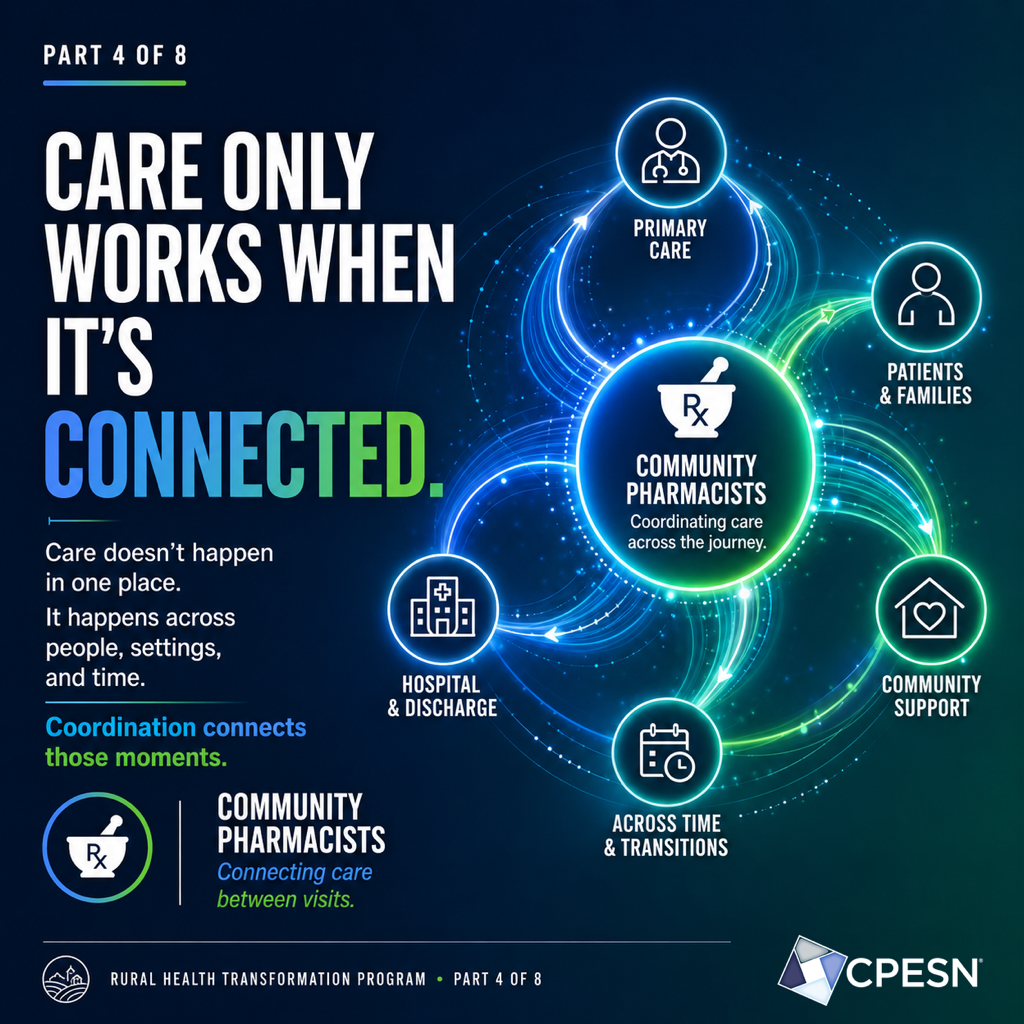
Chronic disease management needs medication safety, adherence support, point-of-care testing where allowed, blood pressure and diabetes follow-up, and care gap closure. Remote patient monitoring needs local touchpoints that can help patients understand the workflow and respond when something changes. Hub-based care coordination needs partners who can identify issues early, document interventions, and connect patients back to the care team. Behavioral health and rural recovery models need medication continuity, naloxone access, referral pathways, and ongoing patient support.
A clinically integrated network of community pharmacies like CPESN can support a care model or initiative by creating shared workflows, documentation expectations, referral pathways, quality reporting, and consistent execution across communities. CPESN is built for this. Rural Health Transformation is moving from planning to action, and community pharmacy needs to be ready.
E.J. Stoepfel RPH, MBA-MHA CPESN® USA Payer-Purchaser-Partner Engagement Lead
References
Arkansas Rural Health Transformation Program. (n.d.). Arkansas Rural Health Transformation Program. Retrieved June 11, 2026, from https://arkansasrhtp.com/
Centers for Medicare & Medicaid Services. (2026, April 10). Rural Health Transformation (RHT) Program. U.S. Department of Health and Human Services. https://www.cms.gov/priorities/rural-health-transformation-rht-program/overview
Missouri Department of Social Services. (n.d.). ToRCH. Retrieved June 11, 2026, from https://mydss.mo.gov/mhd/ToRCH
Nebraska Department of Health and Human Services. (n.d.). Rural Health Transformation. Retrieved June 11, 2026, from https://dhhs.ne.gov/Pages/Rural-Health-Transformation.aspx
New Mexico Health Care Authority. (n.d.). Rural Health Transformation Program (RHT). Retrieved June 11, 2026, from https://www.hca.nm.gov/rht/
Oklahoma State Department of Health. (n.d.). RHTP funding. Retrieved June 11, 2026, from https://oklahoma.gov/health/rhtp/rhtp-funding.html