
This is the third in a series of Insights posts exploring rural healthcare transformation.
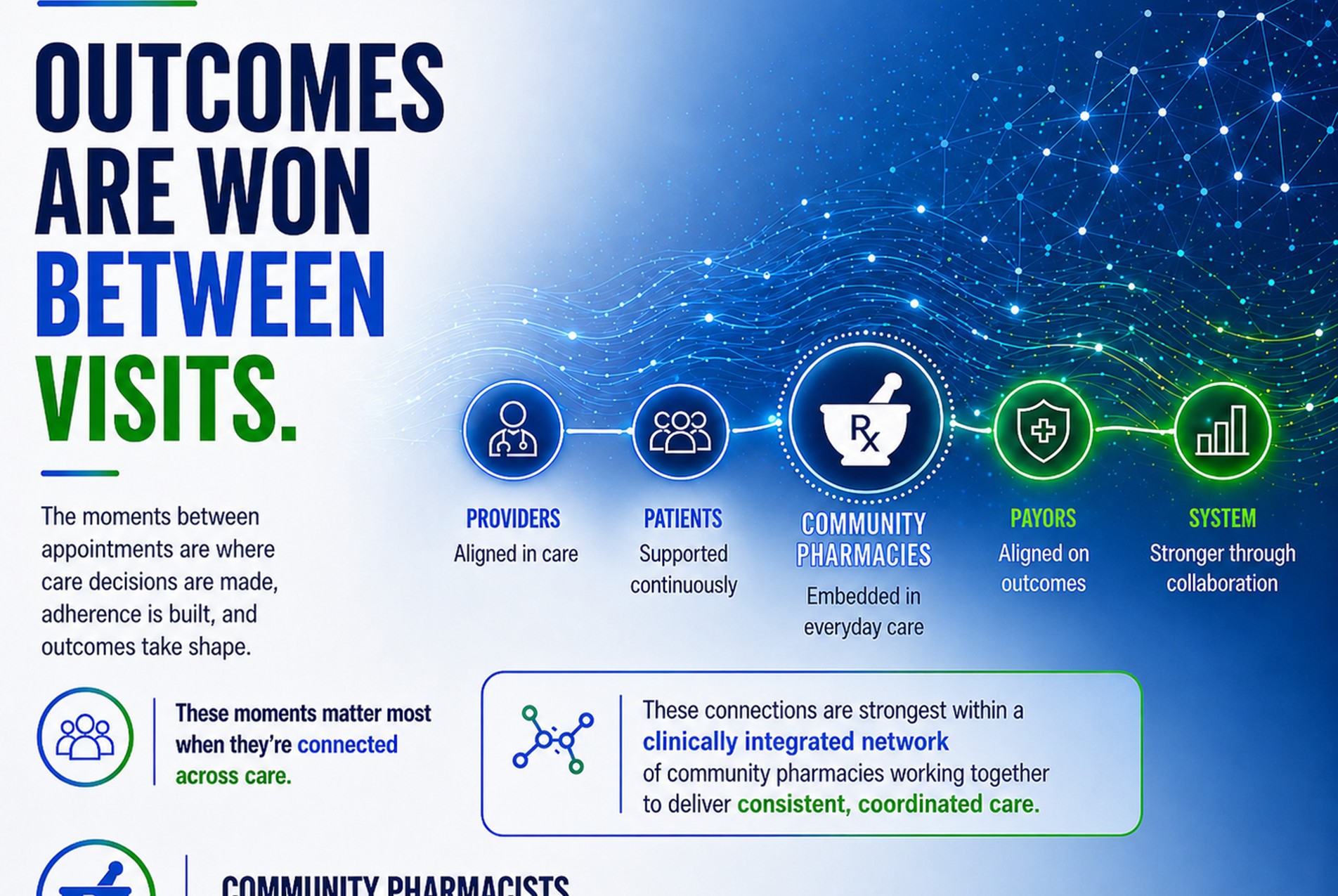
A large part of health is shaped in the space between formal clinical encounters, when people are back home managing medications, symptoms, transportation, cost, family responsibilities, technology barriers, and the realities of daily life. That is especially true across rural America.
Rural communities are not all the same, but many share a common pattern. Care may be spread across longer distances. Specialty access may require travel. Workforce capacity may be limited. A therapy change, missed refill, unresolved side effect, or gap in follow-up can carry more weight when the next touchpoint is not close by. This is where community pharmacy becomes an important part of rural health conversations. Community pharmacists are often one of the most accessible clinical touchpoints in a rural community. Pharmacists see patients between physician visits, after hospital discharges, during therapy changes, and when questions or barriers first surface. Pharmacists help patients understand medications, monitor adherence, identify safety concerns, support vaccinations, provide point-of-care testing where permitted, and recognize when additional support may be needed.
The Rural Health Transformation Program is focused on the space where pharmacists have been for years. CMS describes RHTP as a state-led effort to strengthen rural health care through transformation rather than isolated activity. Several state abstracts and narratives show the same direction in practical terms. West Virginia describes a Connected Care Grid with telehealth, remote monitoring, and local care coordination. Wisconsin emphasizes rural workforce capacity, community health workers, closed-loop referrals, telehealth, and digital infrastructure. Wyoming specifically references scope flexibility for pharmacists and clinically integrated care coordination. These examples matter because they show that transformation is not only about building new programs. It is about connecting the practical parts of care that already touch patients every day.
For pharmacists, the opportunity is to strengthen the entire care team’s reach between visits. That may include medication reconciliation after a transition of care, chronic care management support, immunization outreach, point-of-care testing, maternal health touchpoints, behavioral health screening conversations, social determinant of health referrals, or helping close a care gap before it becomes more complex. This is also where a clinically integrated network of community pharmacies can become especially valuable. A coordinated network can help make that impact easier to identify, scale, measure, and align with payer, provider, and state priorities. Clinically Integrated Networks can support shared workflows, documentation expectations, quality reporting, referral pathways, and consistent execution across rural communities that still need local flexibility. Rural health transformation will require strong hospitals, strong primary care, strong emergency medical services, strong community-based partners, and strong care teams. CPESN is built for this.
E.J. Stoepfel RPH, MBA-MHA CPESN USA Payer-Purchaser-Partner Engagement Lead
References
1. Centers for Medicare & Medicaid Services. (2026). Rural Health Transformation (RHT) Program: Overview. https://www.cms.gov/priorities/rural-health-transformation-rht-program/overview
2. Centers for Medicare & Medicaid Services. (2026). RHT Program State project abstracts. West Virginia abstract: Connected Care Grid, telehealth, remote monitoring, and local care coordination. https://www.cms.gov/files/document/rht-program-state-provided-abstracts.pdf
3. Centers for Medicare & Medicaid Services. (2026). RHT Program State project abstracts. Wisconsin abstract: rural workforce, community health workers, closed-loop referrals, telehealth, and digital infrastructure. https://www.cms.gov/files/document/rht-program-state-provided-abstracts.pdf
4. Centers for Medicare & Medicaid Services. (2026). RHT Program State project abstracts. Wyoming abstract: pharmacist scope flexibility and clinically integrated care coordination. https://www.cms.gov/files/document/rht-program-state-provided-abstracts.pdf